
The Charge
Heart of Iowa Community Services, one of Iowa’s 13-county mental health and disability service regions, engaged Rural Policy Partners to provide strategic planning and transition support during a major statewide behavioral health system redesign.
HICS was responsible for coordinating access to mental health, disability, crisis, and children’s behavioral health services across its region. As Iowa moved toward a new statewide administrative structure, HICS faced a difficult challenge: maintain existing services and provider relationships while preparing for an uncertain organizational future.
RPP was engaged to help HICS leadership evaluate future opportunities, establish strategic priorities, and develop an actionable framework for navigating the transition.
The System Challenge
Iowa’s behavioral health redesign fundamentally changed the role of regional mental health and disability service organizations. For HICS, the transition introduced competing priorities and significant uncertainty.
Leadership needed to address several challenges simultaneously:
- Sustain regional operations and maintain access to services during the transition.
- Evaluate potential roles within the newly designed behavioral health system.
- Support employees facing uncertain organizational and employment futures.
- Help contracted providers prepare for changes in funding, contracting, and service administration.
- Prepare for an orderly transfer or closeout of regional responsibilities.
These challenges were compounded by evolving state guidance, compressed timelines, and decisions that depended on factors outside the region’s control.
The central challenge was not simply preparing for organizational change. It was determining how to make responsible strategic decisions while continuing to meet the needs of individuals, providers, and communities.
Rural Policy Partners’ System Design Approach
RPP worked alongside HICS leadership to develop a strategic framework that balanced future opportunities with immediate operational responsibilities. The approach focused on three interconnected areas
Evaluating Future Organizational Opportunities
RPP supported HICS in assessing its potential role within Iowa’s emerging behavioral health system, including opportunities to serve as an Administrative Service Organization (ASO) or continue providing services through new contracting arrangements.
This work included evaluating organizational structures, potential partnerships, service offerings, financial considerations, and the requirements of the new system
Maintaining Operations and Supporting Stakeholders
Recognizing that statewide redesign would not eliminate the need for local services, RPP helped HICS establish priorities for sustaining operations through the transition.
Planning addressed workforce retention, staff communication, provider relationships, service development, and the ongoing responsibilities of regional administration.
Particular attention was given to helping existing provider organizations anticipate changes and prepare for continued service delivery under a different administrative structure
Preparing for an Orderly Transition
RPP helped HICS develop a structured approach to transitioning or closing out its regional responsibilities.
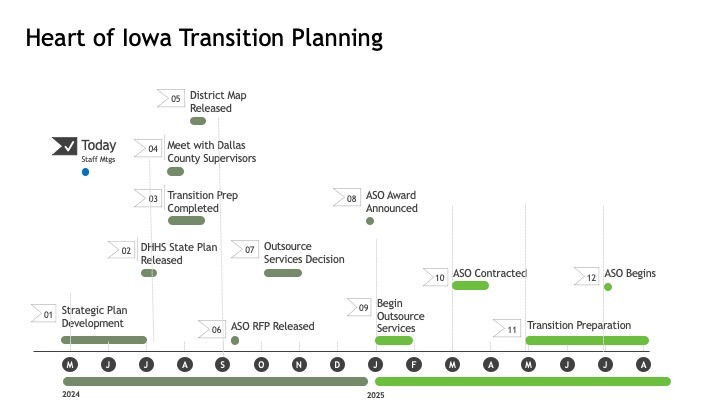
The planning framework identified critical activities involving state coordination, provider contracts, financial obligations, workforce considerations, and organizational closeout.
By organizing these activities alongside future organizational opportunities, HICS leadership could evaluate multiple pathways without losing sight of its immediate responsibilities.
System-Level Insight
A central lesson from the HICS engagement was that successful system redesign requires organizations to plan for two realities at once: the future system being created and the existing system that must continue functioning.
Strategic planning in this environment cannot focus exclusively on future organizational positioning. It must also account for the people, relationships, contracts, and services that remain essential throughout the transition.
The question shifted from “What will our organization become?” to “How do we responsibly manage today’s obligations while preparing for tomorrow’s system?”
That distinction helped frame the HICS strategic plan around both future opportunities and continuity of existing responsibilities.
“System redesign requires more than compliance with a new structure. It requires local leaders to make disciplined decisions while protecting access, relationships, and continuity of care.”
Outcomes and Impact
A Defined Strategic Roadmap
RPP supported development of a strategic plan organized around five priorities: evaluating ASO opportunities, exploring future service contracting, sustaining operations, supporting existing providers, and preparing for organizational closeout.
The plan established objectives, action steps, and timelines to guide leadership decisions during a rapidly evolving transition.
Clearer Organizational Decision-Making
The framework helped leadership distinguish between immediate operational requirements, strategic opportunities, and longer-term transition obligations.
This provided a more organized approach to evaluating alternatives, setting priorities, and responding to changing state requirements.
A Framework for Responsible Transition
By incorporating staff, provider, financial, and administrative considerations into the strategic plan, HICS had a structured process for preparing for the transition while maintaining attention to service continuity.
Rather than focusing solely on the organization’s future, the planning process kept the broader regional service system and its stakeholders in view.
Why Iowa’s Experience Matters
Statewide behavioral health redesign does not occur in isolation. Changes in governance and funding structures create immediate operational consequences for local organizations, providers, employees, and the individuals who rely on their services.
The HICS experience demonstrates why effective system transition requires more than a new organizational chart or implementation timeline. It requires strategic planning that connects policy changes to operational realities, defines responsibilities, and anticipates how decisions will affect the existing service network.
For rural and regional behavioral health systems, protecting continuity while preparing for change is essential.
Through its work with HICS, Rural Policy Partners demonstrated how practical strategic planning can help organizations navigate uncertainty, evaluate difficult choices, and maintain focus on the communities they serve.
About Rural Policy Partners
Rural Policy Partners works alongside states, agencies, and community leaders to navigate complex behavioral health system challenges. Our work combines policy expertise, strategic planning, stakeholder engagement, and practical implementation support to help organizations translate system-level change into actionable decisions.
We believe effective systems are built through collaboration, creativity, and candid conversations about what works, what doesn’t, and what needs to change