
Iowa Behavioral Health System Design
Strengthening Structure in a Fragmented System
Iowa Primary Care Association | Statewide Environmental Scan & Landscape Analysis | September – December 2025
Client
Iowa Primary Care Association
The Charge
The Iowa Primary Care Association (PCA) engaged Rural Policy Partners to conduct a statewide environmental scan of behavioral health collaboration efforts across Iowa’s newly aligned system. The charge was not to redesign local systems, but to understand how collaboration was actually functioning across districts, identify where coordination was working, and surface practical opportunities to strengthen continuity of care.
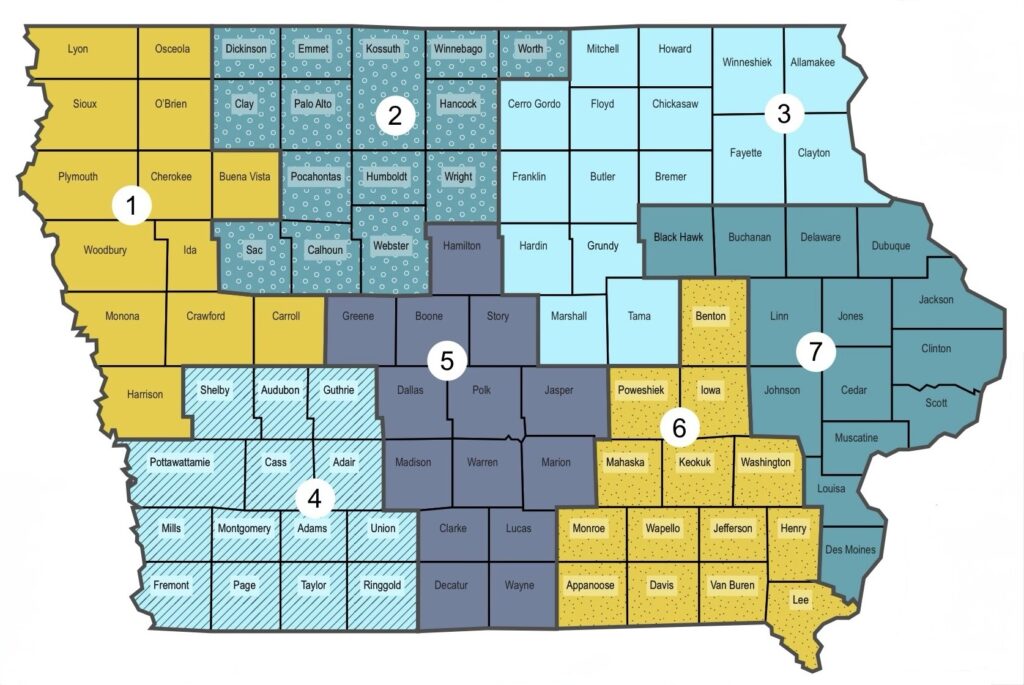
Over a four-month period, RPP facilitated cross-sector engagement across all behavioral health districts, convening providers, hospitals, public health agencies, law enforcement, and community organizations to assess how individuals move through the system in real-world conditions.
🗓️ 5 weeks
📍 7 districts
👥 42 meetings
🚗 3,500 miles
The System Challenge
Iowa’s behavioral health system reflects a common rural reality:
A committed network of providers operating within a complex, fragmented system where individuals must navigate multiple agencies, service levels, and transitions of care.
While collaboration was widely valued, it was not consistently structured.
As a result, these challenges arose:
- Care coordination often depended on personal relationships rather than defined processes
- Navigation roles were overlapping, unclear, and duplicative
- Emergency departments became the default entry point for stabilization
- Mobile crisis response and follow-up varied widely across communities
- Transportation gaps directly disrupted care continuity
Despite years of investment in pilot programs and regional initiatives, collaboration remained inconsistent and difficult to sustain at scale.
Rural Policy Partner’s System Design Approach
Rural Policy Partners grounded this work in a simple but disciplined approach:
RPP facilitated more than 40 cross-sector meetings across seven districts, engaging stakeholders directly in conversations about what is working, what is not, and where breakdowns occur in real time.
Rather than relying on reported models or policy intent, RPP focused on how the system actually functions:
– How individuals enter care
– Where handoffs succeed or fail
– What happens during crisis and transition points
Insights were not treated as isolated local issues. RPP synthesized consistent patterns across districts to identify system-level drivers of performance.
System Level Insight
A critical shift emerged through stakeholder engagement:
System performance is not primarily determined by geography, funding, or provider availability. It is determined by structure.
Across all districts, the strongest predictor of effective care coordination was the presence of:
- Regular, cross-agency collaboration forums
- Defined workflows and shared expectations
- Clear role alignment across providers
Where these structures existed, communities experienced:
- Fewer crisis escalation loops
- More reliable care transitions
- Reduced burden on individuals and families
Where they did not, coordination remained fragile, inconsistent, and dependent on individual effort.
This reframed the conversation from:
“Why isn’t collaboration working?” to “What structure is in place to support it?”
Outcomes & Impact
System Alignment
The environmental scan provided Iowa Primary Care Association and district leaders with a clear, shared understanding of what is driving system performance across the state. Rather than attributing variation to geography or resources, the work clarified that structure—defined collaboration processes, role clarity, and shared expectations—is the primary determinant of effective care coordination. This shift created alignment among stakeholders and reframed how collaboration efforts are understood and prioritized moving forward.
Actionable System Design
Building on this clarity, Rural Policy Partners delivered a set of actionable, system-level recommendations focused on:
- Strengthening collaboration infrastructure
- Improving crisis response and follow-up consistency
- Clarifying roles across the continuum of care
- Supporting more reliable care transitions
These recommendations moved the conversation beyond general collaboration toward defined, repeatable system processes.
Positioned for Implementation
The recommendations aligned directly with Iowa’s statewide behavioral health and rural transformation strategies, positioning Iowa Primary Care Association and district leaders to move from informal, relationship-based coordination toward sustainable, repeatable system implementation.
“RPP helped us move from conversation to clarity. We’ve talked about collaboration for years—this was the first time we understood what it actually requires.”
Why Iowa’s Experience Matters
Many states invest heavily in programs, services, and workforce expansion. But without structure:
- Collaboration remains inconsistent
- Systems rely on individual relationships
- Outcomes vary widely across communities
Iowa’s experience demonstrates a broader truth: Improving behavioral health systems is not only about adding resources. It is about designing the structure that allows those resources to function as a system.
Structure is what turns collaboration into a functioning system.
About Rural Policy Partners
Rural Policy Partners works alongside states, health systems, and community leaders to bring structure to complex behavioral health systems.
We specialize in:
- Cross-sector facilitation
- Rural system design
- Translating stakeholder input into actionable strategy
Our work is grounded in real-world conditions—where policy, operations, and community dynamics intersect.